Santanu Dey • Halina Marlewicz
Part 1 of the series examined the sacred grove of Mawphlang as a living cultural landscape shaped by religious practice, ancestral memory, customary governance, and environmental stewardship.
Part 2 turns to another dimension of place-making: the transformation and representation of mountain settlements during the nineteenth and early twentieth centuries.
The two contributions approach this process from complementary perspectives. Santanu Dey compares the development of Zakopane and Darjeeling, asking how different factors helped produce two distinct forms of mountain modernity. Roads, railways, health institutions, commercial networks, migration, and tourism transformed the places themselves, while newspapers, archives, architecture, and public discourse shaped their identities. The next contribution by Halina Marlewicz remains in Darjeeling and the eastern Himalayas, but changes the perspective of enquiry. It asks how Darjeeling and neighbouring Sikkim entered the Polish imagination through missionary texts and engravings. If the comparison of Darjeeling and Zakopane shows how mountain towns were materially and institutionally made, the next contribution considers how Darjeeling and neighbouring Sikkim were made legible to readers who had never visited the Himalayas. It turns from roads, railways, migration, and urban development to the circulation of descriptions and images in nineteenth-century Polish missionary print.
Together, the essays explore how mountain places were materially transformed and culturally mediated for local, colonial, and transnational audiences.
Making Mountain Towns: Zakopane and Darjeeling in Comparative Perspective
Santanu Dey
A Tale of Two Mountain Towns
During the nineteenth century, mountain settlements in different parts of the world were transformed by new forms of tourism, transport, medicine, migration, and economic development. Zakopane, in the Polish Tatras, and Darjeeling, in the eastern Himalayas, offer an illuminating comparison. Although both became increasingly connected to distant urban centres, attracted visitors in search of mountain scenery and healthier climates, acquired new connections, institutions, and cultural identities, they developed under markedly different political and economic conditions . Zakopane developed through the interaction of highland society, medical tourism, and Polish cultural nationalism, whereas Darjeeling emerged as a colonial hill station shaped by British administration, commercial tea cultivation, labour migration, and imperial infrastructure.
Contemporary documents reveal how these transformations were understood by the people and authorities involved. For Zakopane, Andrzej Chramiec’s 1896 report Zakopane: stacya klimatyczna, sprawozdanie z 10-ciu lat istnienia i krótki opis, published by the Climate Commission, provides a contemporary account of the development of the health resort. The local periodical Przegląd Zakopiański, first published in the 1890s, offers another perspective on the concerns of the emerging resort community. For Darjeeling, colonial administrative documents, records of the Sikkim Palace Archives, colonial administrative documents, and the growth of Nepali-language print culture provide complementary ways to investigate the relationship between political authority, migration, and local identity. These sources also expose an important methodological issue: the history of a mountain town depends partly on whose experiences were recorded and whose voices remained marginal.
Zakopane: Climate, Health, and National Culture
Zakopane’s transformation accelerated during the second half of the nineteenth century, when visitors from the Polish lowlands increasingly regarded the Tatras as a destination for recreation, scientific exploration, and recuperation. Poland was then partitioned among neighbouring empires, and Polish intellectuals invested the mountainous southern borderlands of the partitioned Polish lands with cultural and national significance. The physician Tytus Chałubiński played an influential role in popularising the region, promoting its climate and mountain environment while encouraging interest in local highland culture. The Tatra Museum, established in 1888 by his associates, institutionalised this growing interest in the natural and cultural history of the region. Its early collections combined ethnographic materials with botanical, geological, and zoological specimens.
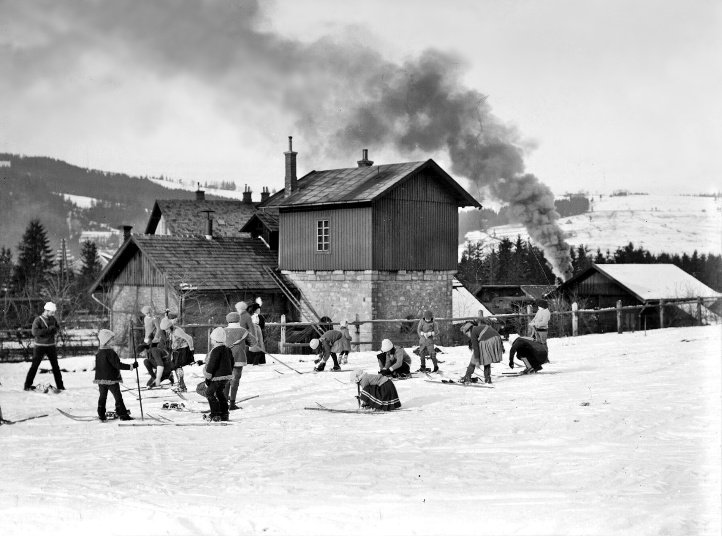
Chramiec’s 1896 report on the first ten years of existence of Zakopane’s climate station documents the institutional promotion of the town as a health resort. Published by the Komisja Klimatyczna (Climate Commission), it presents Zakopane not simply as a picturesque mountain settlement, but as a locality whose climate and environment had recognised therapeutic value. The report belongs to the administrative and medical framework through which the resort’s development was measured, promoted, and legitimised.
Highland Culture and the Making of Zakopane
The medical appeal of the Tatras was only one element of Zakopane’s development. The arrival of visitors generated demand for accommodation, transport, services and local construction, creating new relationships between highland residents and the educated urban visitors who increasingly shaped the town’s public image.
The Górale, the highland communities of the Podhale region, became central to this process. Their music, clothing, building traditions, and everyday practices attracted artists, ethnographers, and tourists. Tourism and ethnographic interest did not merely preserve an unchanged highland culture. As Timothy J. Cooley argues in Making Music in the Polish Tatras, they also helped shape the very practices that outsiders came to regard as characteristic of the Górale. Local craftspeople, builders, musicians and performers actively participated in this process, although visitors, patrons, designers, and cultural elites also influenced how highland traditions were represented. Cultural representation was thus part of the process of modernisation itself: practices acquired new visibility and economic value while also being selected, interpreted, and sometimes reformulated.
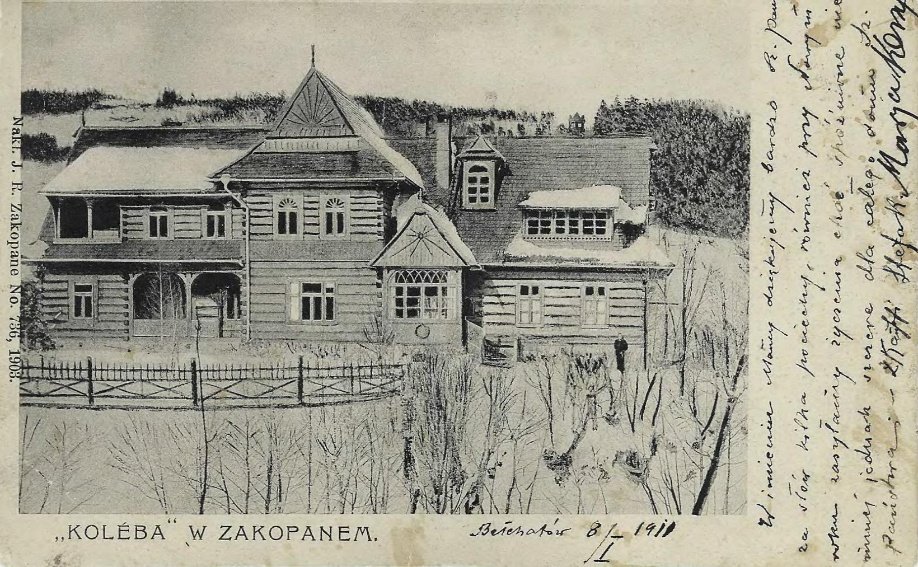
The Zakopane Style in architecture illustrates this negotiation particularly clearly. The architectural identity of the town was neither simply imposed from the outside nor inherited unchanged from the past. It was developed as the first Polish national style carried out in practice by Stanisław Witkiewicz (18151-1915). The artist, as mentioned by Zbigniew Moździerz in his 2011 essay, “considered the highlander carpenters and woodcarvers to be co-creators of the architecture he designed” (Stanisław Witkiewicz – Creator of the Zakopane Style https://culture.pl/en/artist/stanislaw-witkiewicz-creator-of-the-zakopane-style).
Newspapers, Railways, and Everyday Life
The architectural style was only one expression of Zakopane’s transformation. Local newspapers and railway records show how the emerging resort also acquired the institutions, services, and transport connections of a modern town.
The digitised issue of Przegląd Zakopiański dated 2 November 1899 describes the periodical as a publication devoted to local affairs. Its notices concerning reading rooms, institutions, religious services, and commercial addresses reveal aspects of the social infrastructure that accompanied the growth of the resort. Such details are valuable because they bring the town into view as a lived community, rather than merely a destination for visitors.
The railway connection that opened in 1899 altered Zakopane’s relationship with the outside world. It strengthened accessibility and supported the movement of tourists and goods. The railway planning records preserved by the Kórnik Library document the institutional and technical dimensions of this transformation. In conjunction with Chramiec’s report and local journalism, they show that the growth of the resort resulted from medical promotion, commercial development, and changing mobility patterns.
Darjeeling: Colonial Administration, Tea, and Migration
Darjeeling followed a different path. Before its incorporation into British-controlled territory, the area belonged to the political sphere of Sikkim and was affected by wider regional conflicts involving Sikkim and Nepal. In 1835, the East India Company acquired Darjeeling from the ruler of Sikkim. The meaning and terms of this territorial transfer appear differently when British administrative records are read alongside material from the Sikkim Palace Archives.
Under British administration, the settlement developed into a hill station intended to provide a cooler environment for European officials and visitors. Roads, accommodation, administrative buildings, and medical facilities gradually established the town as a centre of colonial activity. The official district history records the early expansion of roads and buildings and the efforts of the administration to encourage settlement, commerce, and agricultural experimentation.
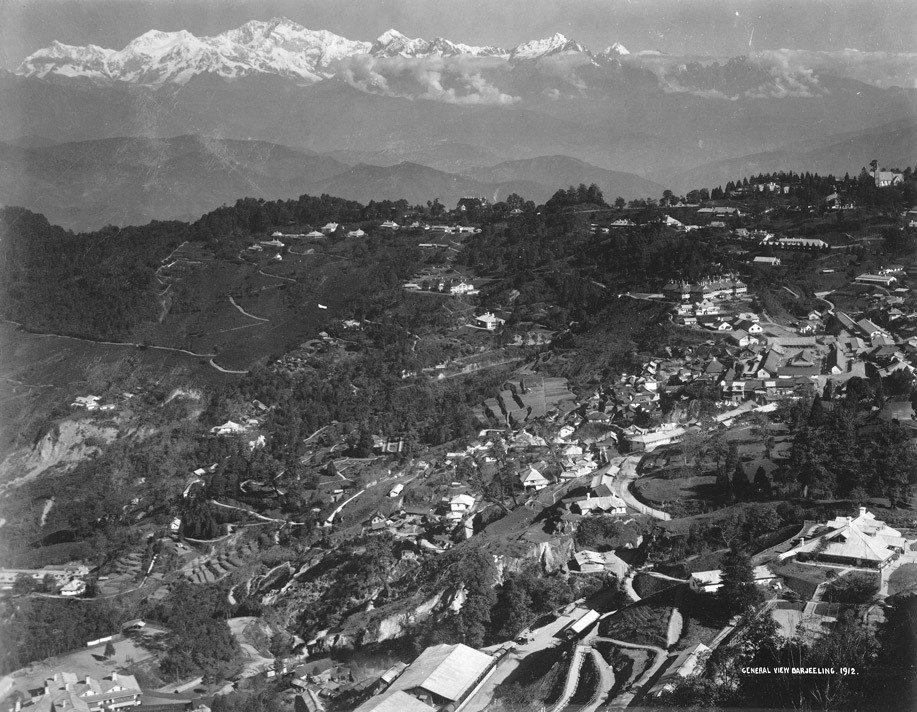
Its growth was therefore not simply the result of a growing tourist market; it was closely connected to the territorial ambitions and administrative priorities of the colonial state.
Tea, Labour, and Migration
Darjeeling’s growth depended on more than administration and tourism. The expansion of commercial tea cultivation required land, labour, transport and new organisational systems. It encouraged migration from Nepal and other neighbouring regions while transforming the surrounding hills into a plantation landscape.
These changes affected existing communities and produced an ethnically and linguistically diverse social world. Darjeeling’s social identity developed through migration, work, political classification, and cultural exchange rather than from a single, uniform tradition. Its history cannot therefore be reconstructed adequately through the activities of British officials and plantation owners alone.
Railway and Connectivity
The Darjeeling Himalayan Railway opened in 1881, connecting the hill station with the plains and facilitating the movement of passengers and goods. Its importance extended beyond tourism: the railway supported the tea economy and strengthened Darjeeling’s larger commercial connections. UNESCO’s historical assessment of India’s mountain railways identifies the Darjeeling line as an important example of the influence of transport infrastructure on the social and economic development of a multicultural region.
Different groups experienced this infrastructure differently. Visitors gained easier access to mountain scenery and a cooler climate. Commercial interests gained a more efficient means of moving goods between plantations and markets. For local populations, the railway was part of a broader transformation that involved employment, migration, and changing relationships between settlements. These effects were interconnected, but they were not identical.
Print Culture and Alternative Archives
Local-language print culture offers another route into Darjeeling’s social history. According to the Darjeeling History Club’s account of newspaper publishing, Gorkhe Khabar Kagat, edited by Ganga Prasad Pradhan, began publication in Darjeeling in 1901 and was the first Nepali newspaper in the town. Its emergence points to the development of a public sphere in which Nepali-language readers and writers could participate in discussions of community and identity. Nepali-language print sources recover forms of public expression that colonial administrative documents often marginalise.
The Sikkim Palace Archives provide a different but equally important shift of perspective. Digitised through the British Library’s Endangered Archives Programme, the collection includes materials concerning domestic, foreign, land, and religious affairs, as well as correspondence between Sikkimese rulers and British political officers. A file catalogued as “Cession of Darjeeling” contains documents concerning negotiations over Darjeeling and the Sikkim Terai.
These records allow Darjeeling’s territorial history to be approached through Sikkimese political institutions rather than only through the documentation of the colonial state. The collection has limitations of its own because it largely represents elite and governmental perspectives. Nevertheless, as an archive originating in Sikkimese institutions, it provides an essential counterpoint to British records.
Comparing Mountain Modernities
Zakopane and Darjeeling shared several broad processes. Both became increasingly connected to distant centres through transport and expanding markets. In each place, the mountain scenery and climate acquired economic and cultural value, while visitors, administrators, entrepreneurs, migrants, workers, and local residents contributed to urban transformation.
However, their political conditions differed fundamentally. Zakopane developed in the context of the partitions of Poland and the rise of Polish cultural nationalism. Medical tourism, mountaineering, and interest in the traditions of Górale helped to produce a distinctive regional image with broader national significance. Darjeeling developed under colonial authority through territorial control, plantation production, labour migration, and imperial infrastructure.
The archives reveal another point of comparison. Zakopane’s climate-station report documents the institutional promotion of a health resort, while Przegląd Zakopiański records aspects of everyday public life. In Darjeeling, the Sikkim Palace Archives illuminate territorial negotiation and regional governance, while Nepali-language print culture and the history of plantation labour reveal experiences that official correspondence does not fully represent. These sources are not directly equivalent. Their differences, however, make it possible to ask whose interests development served, whose labour sustained it, and how changing identities entered the historical record.
Conclusion
Zakopane and Darjeeling represent two distinct but interconnected forms of mountain modernity. Both were transformed through mobility, infrastructure, institutional promotion, and encounters between local populations and outside visitors. Yet Zakopane’s development was closely connected to medical tourism, highland culture, and Polish national aspirations, whereas Darjeeling’s growth depended on colonial administration, plantation production, territorial control, and labour migration.
Their histories also demonstrate that mountain towns are not simply discovered by tourists or modernised by railways. They are actively made through relationships among inhabitants, migrants, workers, administrators, entrepreneurs, intellectuals, and visitors. Reading official records alongside local newspapers, vernacular print, material culture, and regional archives helps reveal whose labour supported development, whose interests it served, and how changing cultural identities were represented.
Imagining the Himalayas in Nineteenth-Century Missionary Print: Darjeeling and Sikkim in Word and Image
Halina Marlewicz
European Readers Imagine the Himalayas
How did nineteenth-century European readers imagine the Himalayas without travelling there? Their impressions were shaped not only by scientific publications, colonial archives, and travel accounts, but also by missionary periodicals, illustrated magazines, translations, photographs, and engravings. These media brought distant regions into European homes, while organising the categories through which readers interpreted them.
A revealing example appears in the Polish Jesuit monthly Misje Katolickie (Catholic Missions). In 1891, the magazine published a three-part series entitled “Darjeeling and Sikkim in the Himalayas.” Combining geographical description, ethnographic observation, missionary commentary and photographs-based engravings, the reports introduced Polish readers to the landscapes and inhabitants of the eastern Himalayas. They also constructed a particular image of the region: majestic yet dangerous, culturally diverse yet classified through European categories, spiritually charged yet represented as religiously different from Christian Europe.
A Polish Window into Darjeeling and Sikkim
Founded by the Jesuits in 1882, Misje Katolickie was the first major Polish-language illustrated missionary periodical with a broad national readership. It combined religious, educational, geographical, and ethnographic material. The 1891 Himalayan series was adapted from reports published in the French periodical Les Missions Catholiques.
Its principal source was an account by Claude Saleur of the Société des Missions Étrangères de Paris, who worked as a missionary in Darjeeling and Sikkim during the 1880s. His French report appeared in six instalments in 1887 and was accompanied by illustrations.
Translation as Cultural Mediation
The Polish version was not a straightforward translation. Its editors selected and condensed passages, reorganised the material, and changed certain emphases. Therefore, knowledge did not travel unchanged from the Himalayas to France and then to Poland. At each stage, it was edited and adapted for a new institutional setting and readership.
Comparing the French and Polish versions reveals the translation not as a neutral transfer of information, but as a process of cultural mediation. Small changes in vocabulary, selection, and structure could intensify particular qualities of the landscape, strengthen religious classifications, or alter the relationship between geographical description and missionary interpretation.
Mountains as Boundary and Frontier
In Polish reports, the Himalayas are more than a physical formation. They function as a boundary separating British India from Tibet, the accessible from the remote, and the familiar from what the periodical presented as culturally and religiously unfamiliar. The mountains become a frontier of travel, missionary activity, political influence, and European knowledge.
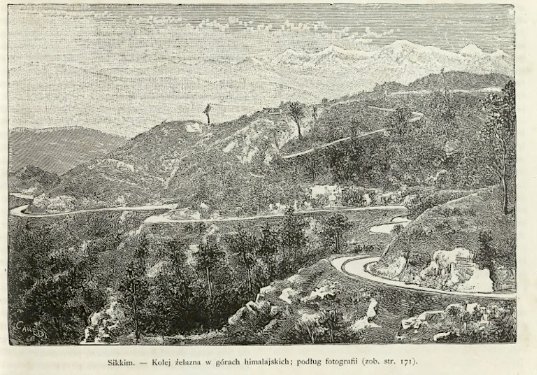
Comparison with the French source reveals how editorial choices intensified this representation. The French description of the Himalayas as a “noble frontier” becomes a “more powerful frontier” in Polish. References to picturesque qualities are replaced by language that emphasises splendour and majesty. These apparently small shifts make the Polish Himalayas seem more monumental and inaccessible.
The engraving of the mountain railway introduces modern infrastructure into a landscape that remains visually dominant. It promises movement and access, but the surrounding mountains retain their magnitude and apparent remoteness. The railway is therefore both a material sign of connection and a visual device through which readers could imagine the tension between modern mobility and Himalayan distance.
Sikkim between Different Worlds
The reports position Sikkim as an intermediate space between Tibet and British India. The region appears in relation to Tibetan religious influences, trade, migration, missionary activity, and the expansion of the colonial infrastructure. Darjeeling, on the contrary, is presented as a modern colonial town of administrative buildings, schools, missions, tea plantations, and transport connections.
The contrast makes Sikkim appear as Darjeeling’s frontier and hinterland: geographically close and economically connected, but culturally more distant from the European observer. In this narrative, Sikkim is interpreted primarily through its relationship to the surrounding political and religious worlds rather than through its own historical categories.
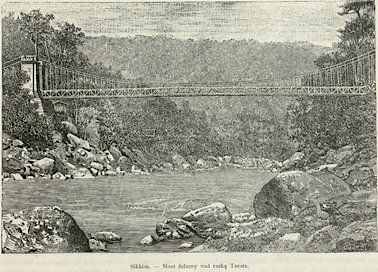
The bridge visible in the engraving is more than an element of the landscape. It suggests connection while making visible the separation it overcomes. Such images reinforced the idea of Sikkim as a liminal region linked to wider political and economic networks, yet situated on their margins.
A Spiritually Animated Landscape
The reports also describe the Lepcha traditions concerning spiritual agencies associated with rocks, mountains, and forests. Within the Polish missionary narrative, these accounts present the environment as animated by unseen powers capable of affecting human life. However, they should not be treated as transparent descriptions of Lepcha religious traditions. The material is filtered through missionary categories, translation, and editorial choice.
The Polish adaptation sometimes presents these traditions more categorically than the French source. Qualified observations become firmer classifications, sharpening the perceived distinction between local religious life and Christianity. The periodical therefore did not offer a neutral account of Himalayan religion. It organised local practices as signs of difference from Christian Europe.
Reading Missionary Imaginaries Today
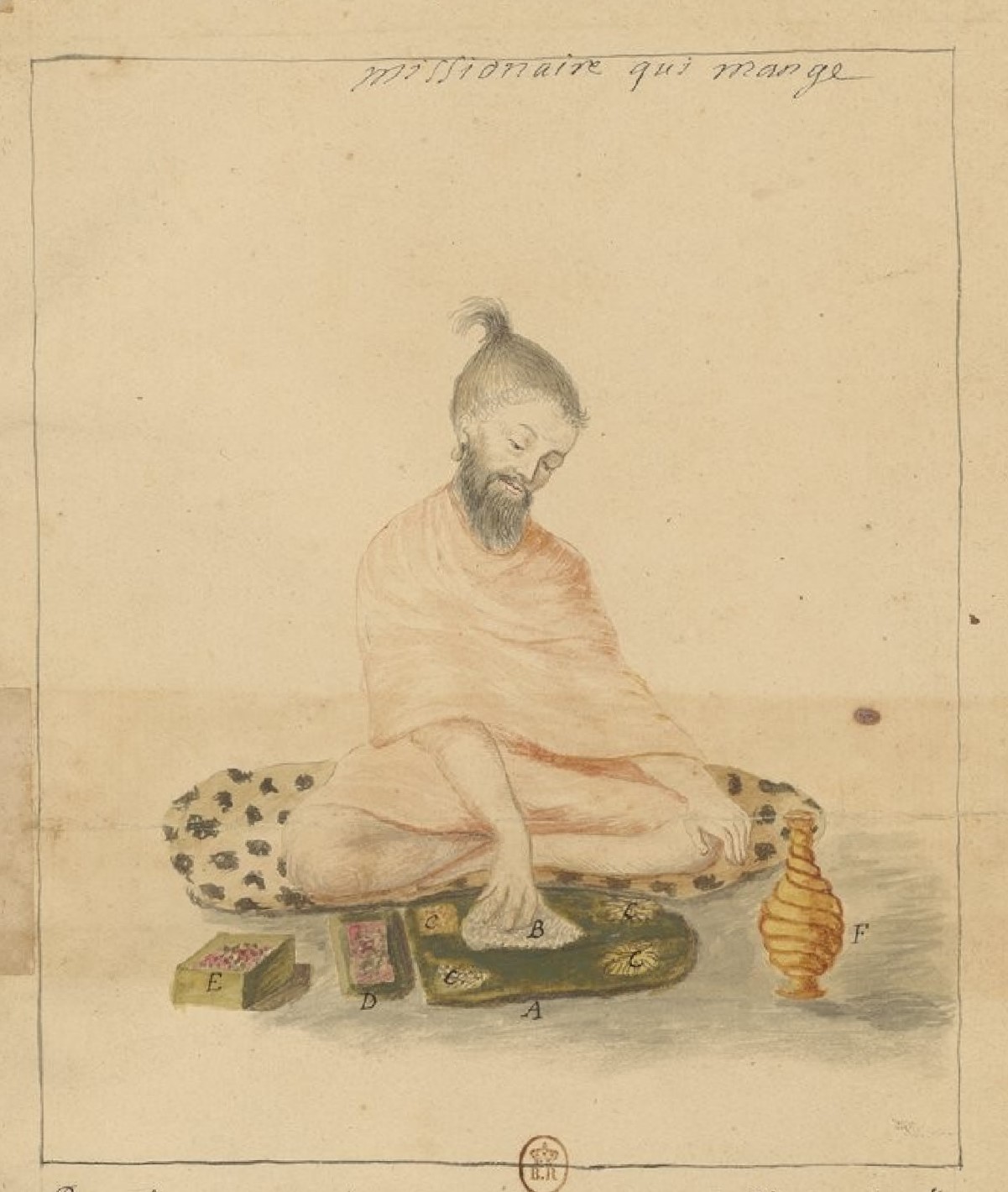
The 1891 Himalayan series demonstrates how text and image worked together to produce geographical, ethnographic, and religious knowledge. The engravings created an impression of visual proximity, the captions classified what the readers saw, and the surrounding narrative placed the images within a missionary worldview. Landscapes became frontiers, infrastructure signified modernisation, and local religious traditions were framed as evidence of difference from Christian Europe.
The value of these reports lies in their layers of mediation. Material originating in the eastern Himalayas circulated through French missionary publishing before being selected, translated, and reshaped for Polish readers. The resulting Himalayas were therefore not simply a distant mountain range reproduced on the page. They were a mediated cultural landscape, created through the international movement of texts and images and adapted to the expectations of a particular European readership.
Next in the Series
Zakopane, Darjeeling, and Sikkim show how mountain places were made through both material transformation and cultural representation. Tourism, medicine, transport, migration, colonial administration, and print culture reshaped towns and landscapes themselves, while archives, periodicals, translations, and images framed how different audiences understood them. Part 3 turns from mountain towns and missionary print to the first Yugoslav expeditions to the Himalayas, examining how mountaineers recorded intercultural encounters and interpreted Himalayan landscapes, communities, and religious traditions between 1960 and 1981.