Santanu Dey • Halina Marlewicz
Parts 1 and 2 of this series examined how mountain environments acquire meaning through sacred practice, community stewardship, urban development, colonial infrastructure, and print representation. The third and final part turns to twentieth-century mountaineering to ask what happened when European climbers encountered Himalayan landscapes and communities directly and subsequently transformed their experiences into journalism, books, photographs, films, and public lectures.
In the contribution that follows, Aljaž Mesner examines the first Yugoslav expeditions to the Himalayas between 1960 and 1981. He considers the cultural assumptions that expedition members brought with them, their dependence on local knowledge and labour, and the ways in which they interpreted food, religious life, sacred mountains, and everyday practices. The author also looks at how individual observations became public narratives through which audiences in Yugoslavia, and particularly in Slovenia, came to imagine the Himalayas.
Intercultural Encounters during the First Yugoslav Expeditions into the Himalayas, 1960–1981
Aljaž Mesner
Yugoslav Expeditions, Slovenian Participants
In1960, a a mountaneering team from Yugoslavia travelled to the Garhwal Himalaya to climb Trisul in India. The journey marked the beginning of a series of eight expeditions known as JAHO I-VIII (Jugoslovanska Alpinistična Himalajska Odprava), undertaken between 1960 and 1981 in India and Nepal. Later teams travelled to Kangbachen, Annapurna, and Makalu in Nepal.
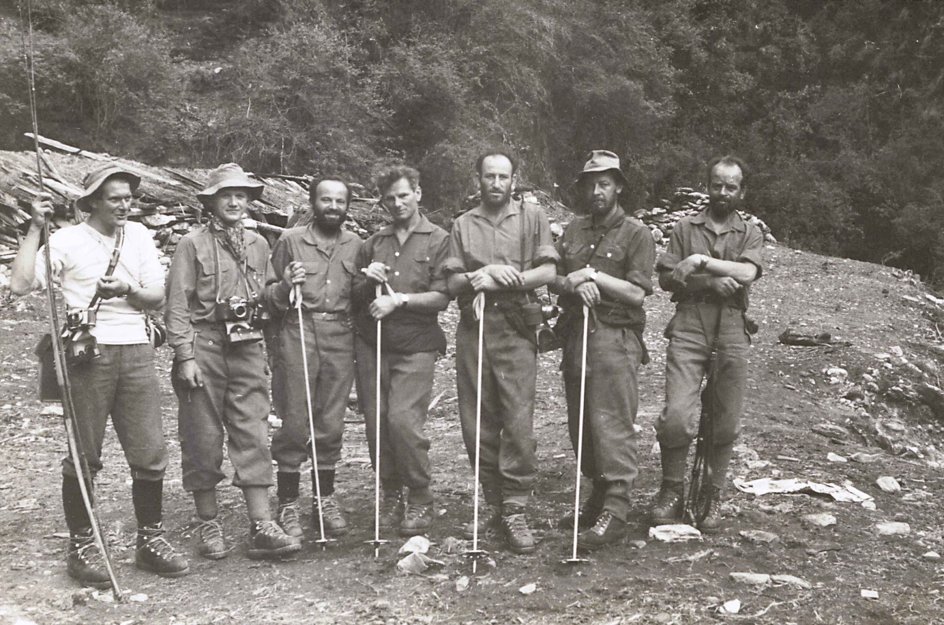
The expeditions were organised principally through Slovenian mountaineering institutions of, especially the Alpine Association of Slovenia, Planinska zveza Slovenije (PZS). ().
Although officially presented as Yugoslav expeditions, their principal teams were predominantly, and sometimes entirely, Slovenian. This distinction matters because the expeditions participated in both a Yugoslav institutional framework and a specifically Slovenian montaneering culture. Their publications therefore need to be considered in relation to federal represenation, institutional sponsorship, and the national and linguistic background of their authors.
Whatever their institutional identity, the expeditions could not operate independently of the regions through which they travelled. Their movement depended on relationships with porters, guides, interpreters, officials, suppliers, and local communities. This practical interdependence created situations in which mountaneering ambitions intersected with cultural exchange, economic inequality, and different understanding of mountain landscapes.
Expeditions as Sites of Intercultural Encounter
The expedition members did more than attempt to reach Himalayan summits. They crossed linguistic, cultural, religious and economic boundaries between European mountaineers and Himalayan societies. Because their operations depended heavily on local knowledge, labor, transport, food supplies, permits, and access to mountain routes, the expeditioners produced rich audio-visual and textual records of the landscapes and communities they encountered. In this sense, they functioned as a sort of ethnographic fieldworker. Reports, photographs, lectures, books, and mountaineering publications transformed these Himalayan experiences into narratives that circulated widely among audiences in Yugoslavia. Originally written in Slovenian, these materials provide evidence of how the mountaneers observed cultural differenc and attempted to interpret unfamiliar paracitces through categories drawn from their own European background.
These observations should not, however, be treated as neutral ethnography. The expedition members were not conducting systematic anthropological fieldwork. Their descriptions emerged from encounters shaped by the priorities of mountaineering, linguistic limitations, time constraints, European assumptions, and dependence on local labour.
They documented a wide range of topics regarding local Himalayan people, including food and drink, interactions with locals, local knowledge systems, the position of women, material culture, vernacular perceptions of mountains, beliefs, religion, housing, and infrastructure. Translating selected passages of their writings into English opens up the experiences, perspectives, and cross-cultural encounters of these early explorers to a broader global audience.
Writing, Photographing, and Filming the Himalayas
Two expedition members were particularly influential in transforming Himalayan experience into public narrative. Zoran Jerin and Aleš Kunaver produced extensive records of their expeditions, although they approached the subject through different forms of documentation.
Zoran Jerin (1925–2005) was a professional journalist associated with major Slovenian newspapers such as Delo. During the expeditions, he sent articles, reports, and essays to newspapers, generating large volumes of texts. He subsequently published books that brought his Himalayan experience to a wider readership.
Aleš Kunaver (1935–1984) served as the principal author of official collective expedition monographs containing contributions from several team members. He also made documentary films, including Dežela Šerp (Land of the Sherpas) for the Yugoslav media, and produced technical guides and educational materials connected with the mountaineering training in Nepal, which he founded, with the aim of transforming high-altitude porters from heavily exploited helpers into skilled and professional mountaineers and guides.
The expedition texts contain curiosity, admiration, and attempts at cross-cultural comparison, but they also preserve assumptions about civilisation, progress, and cultural difference that need to be examined critically.
Food, Health, and the Boundaries of “Civilisation”
Food was one of the most immediate points at which expedition members interpreted cultural difference. During the first expedition to Trisul, some participants approached unfamiliar food primarily as a health risk. Zoran Jerin, for example, wrote that local food “if not poisonous, is at least harmful for our digestive tracts” (Jerin 1978, 126).
Aleš Kunaver similarly commented:
Sherpa cuisine does sometimes show aesthetic weak points, especially if homemade chang beer or spoiled meat sauce is on the menu. Luckily, the sensitivity of European stomachs proportionally decreases with the distance from civilization. (Kunaver 2007, 16)
These statements express more than practical concern about illness. Their language establishes a division between an assumed European norm and the food practices encountered during the expeditions. Terms such as “poisonous,” “spoiled,” and “civilization” create a cultural hierarchy in which European habits serve as the standard against which local practices are evaluated.
Interpreting Monasteries and Religious Life
Although some early accounts express suspicion of or discomfort with unfamiliar practices, other passages combine curiosity and aesthetic admiration with attempts to interpret Himalayan religious life through familiar European categories.
Reflecting on the experience of visiting Tibetan monasteries, Kunaver writes:
For a man from the restless European life, the peace of Tibetan monasteries is something beyond comprehension. Even more incomprehensible are the lives of monks and lamas, in dark enclosures of simple dwellings, where outside, the most wonderful mountain panorama in the world basks in the sun. Still, lamas are not boring people, and they take interest in anything that comes from the outside world, even though they are removed from technology by at least 14 days of walking, and 1000 years of thought. They appeared to me especially secular, when along wailing sounds of enormous ritual horns their plump cheeks smile, and young novices come to life with the music, as if it were jazz. (Kunaver 2007, 54)
The passage combines appreciation with assumptions about cultural and historical distance. The monastery is presented as peaceful and situated within a magnificent landscape, yet its inhabitants are simultaneously placed “1000 years” behind the European observer. Curiosity and admiration therefore coexist with a hierarchical understanding of historical development.
This ambivalence is characteristic of many expedition narratives. Their authors tried to interpret unfamiliar religious practices but often did so through comparisons that reinforced a distinction between a modern European observer and a supposedly timeless Himalayan world.
Climbing in Sacred Landscapes
Religious institutions were not the only focus of expeditionary interpretation. The mountaineers also encountered understandings of the mountains themselves as sacred or spiritually inhabited places.
Marjan Keršič – Belač (1920–2003), a sculptor and artist for whom JAHO I was the only Himalayan expedition, recorded his experiences in his diaries Noči in viharji (Nights and Storms) His writings reflect his artistic and aesthetic sensibilities, alongside a sense of reverence for the religious landscape through which they were treading, for them at least, new ground.
He wrote:
If people in Europe believe in miracles of immaculate Madonnas, why would these people, without any learning, not believe in golden courts of the goddess Nanda Devi on white peaks, and in a long-haired, terrifying snowman, which wanders around remote glaciers and white slopes, beneath the stars? Why would they not believe in punishment of the mortals, who can be killed by the evil spirits of Sukpa, Zhidagi and Niti, if they dared to climb into the kingdom of gods and goddesses, which protect mankind from these demons? (Keršič 1962, 82)
The mountaineers note that the people they were encountering held mountains in high regard through such myths and stories. Kunaver recounts that, when they were approaching the summit of Trisul, most of their porters turned around in reverence (Kunaver 1988, 34), while Keršič wrote the following:
The sacred mountains, which the locals believe are the abodes of gods, spirits and demons, are now very close to us. It does not come as a surprise that such beliefs are present among these poor, simple and infinitely honest people, whose lives on this barren and rough land depend, so many times per year, on countless natural phenomena which take place somewhere on the white peaks or above them… (Keršič 1962, 82)
Through these select passages, we can begin to see how the writings of these early Slovenian mountaineers and explorers offer us precious insight into the encounters of Europeans with the peoples of the Himalayas throughout the second half of the 20th century. Further study and translation work will undoubtedly reveal the complexities of such cross-cultural encounters and paint a vivid picture of life in the Himalayas as seen through the eyes of these alpinists.
References
Jerin, Zoran. 1978. Himalaja, rad te imam. Ljubljana: Mladinska knjiga.
Keršič, Marjan. 1962. Noči in viharji: Dnevnik poti prve slovenske odprave na vrhove Trisulov v Garhval Himalaji v letu 1960. Ljubljana: Mladinska knjiga.
Kunaver, Aleš. 1988. Aleš Kunaver. Maribor: Obzorja.
Kunaver, Aleš. 2007. Dežela Šerp – 1962. Ljubljana: Dušica Kunaver.
Concluding the Series
Santanu Dey • Halina Marlewicz
Across its three parts, Making and Imagining Himalayan Worlds has examined how mountain places acquire meaning through indigenous religious practice and environmental stewardship, the development of mountain towns, missionary print culture, and twentieth-century mountaineering encounters. From the sacred grove of Mawphlang and the contrasting histories of Zakopane and Darjeeling to Polish representations of Sikkim and Yugoslav expedition narratives, the contributions show that Himalayan worlds are made through relationships among landscapes, communities, institutions, labour, texts, images, and travel. These interconnected studies reflect the ESIND Himalayan research cluster’s wider effort to bring European archives into dialogue with South Asian histories, local knowledge, and lesser-known perspectives through collaborative research, resource exchange, publications, and future scholarly meetings.
This three-part series emerges from the work of the ESIND research cluster Ethno-spatial and Sacred Imaginaries: Locating the Himalayas in the European Imagination. The cluster brings together researchers working on sacred landscapes, visual and missionary culture, environmental history, colonial and postcolonial constructions of space, mountain urbanisation, expedition archives, and the transnational circulation of Himalayan knowledge. Its members combine European archival sources with South Asian histories, community practices, vernacular materials, and regional perspectives.
The ESIND Himalayan Research Cluster
ESIND members and other researchers working on Himalayan landscapes and communities, sacred geography, visual and missionary cultures, environmental history, borderlands, mountaineering, exploration, or the circulation of knowledge between South Asia and Europe are warmly invited to join the cluster and contribute to its future research, publications, resource-sharing initiatives, and scholarly events. Interested researchers may contact the cluster co-convenors, Santanu Dey and Halina Marlewicz.
Cluster co-convenors:
Santanu Dey
Jagiellonian University and University of Calcutta
Email: santanu.dey@uj.edu.pl
Santanu Dey’s research within the cluster examines Himalayan and mountain imaginaries through comparative urban, cultural, and print history. His current work includes a comparative study of Darjeeling and Zakopane, focusing on the development of mountain towns through tourism, transport, health practices, migration, labour, colonial administration, and cultural identity. He is also investigating perceptions of the Himalayas in Bengali vernacular journals of the late nineteenth and early twentieth centuries.
Halina Marlewicz
agiellonian University
Email: halina.marlewicz@uj.edu.pl
Halina Marlewicz studies European visual, missionary, literary, and religious representations of the Himalayas. Her research for the cluster investigates illustrated missionary print, especially the Polish Jesuit monthly Misje katolickie, as well as the interaction between texts, photographs, and engravings in the production of Himalayan knowledge. Her wider interests within the cluster include sacred geography, cultural translation, and contemporary literary and visual voices from the Himalayan borderlands.
Cluster members:
Srijani Bhattacharjee
Amity University Kolkata
Srijani Bhattacharjee researches sacred landscapes, community heritage, environmental history, and European scientific engagement with the Eastern Himalayas. Her work on the Mawphlang sacred grove examines Khasi religious practice, community governance, biodiversity preservation, and the effects of colonial and postcolonial change. Her wider cluster research also addresses botanical expeditions, colonial scientific knowledge, cartographic imaginaries, and European engagements with present-day Arunachal Pradesh and neighbouring Himalayan regions.
Evakordor Benson Diengdoh
Religious Studies Department, University of Tartu
Evakordor Benson Diengdoh researches ritual practice, sacred space, identity, and belonging among Khasi communities in Meghalaya. Her cluster project examines how colonial administration and Christian missionary activity transformed physical and sacred landscapes through mapping, governance, education, and evangelisation. It also considers Indigenous responses to religious and cultural change and the ways local communities negotiate and reinterpret their traditions under changing political and social conditions.
Aljaž Mesner
Department of Ethnology and Cultural Anthropology, University of Ljubljana
Aljaž Mesner investigates ethnological and religious perceptions of the Himalayas among Slovenian and Yugoslav mountaineers, particularly during the expeditions undertaken between 1960 and 1981. His work examines mountaineering narratives, photographs, films, and expedition records as sources for understanding intercultural encounters, representations of sacred mountains, and the formation of Himalayan imaginaries in former Yugoslavia.